Mastering Non-Functional Requirements (NFRs) for System Design Success
A Complete Guide to Identifying and Addressing NFRs in System Design Interviews

The Comprehensive Guide to Non-Functional Requirements (NFRs) in System Design
System design interviews often emphasize scalability, reliability, and performance, but the role of Non-Functional Requirements (NFRs) cannot be overstated. While functional requirements define "what" a system does, NFRs address "how" it performs under specific conditions, ensuring the system is robust, efficient, and user-friendly. This guide provides an extensive list of NFRs that can help engineers and architects design high-quality systems.
What Are Non-Functional Requirements (NFRs)?
Non-Functional Requirements specify the quality attributes of a system. They define criteria to judge the system’s operation rather than its specific behaviors. Addressing NFRs ensures the system performs well under various circumstances, meets user expectations, and achieves business goals.
How to Determine Which NFRs Are Relevant
Selecting the appropriate NFRs for a given system design problem is a crucial step in system design interviews. Here are some practical steps to guide you:
Understand the Problem Context:
What is the primary purpose of the system (e.g., e-commerce, real-time chat, payment processing)?
Who are the primary users, and what are their expectations?
Ask Clarifying Questions:
What is the expected load (e.g., users per second, transactions per second)?
Are there any specific uptime or availability requirements?
How sensitive is the system to delays (e.g., latency tolerance)?
Are there security or compliance mandates?
Prioritize Based on Trade-offs:
If low latency is critical, prioritize performance and responsiveness over cost optimization.
For systems handling sensitive data, prioritize security and compliance.
Align with Business Goals:
Does the system need to scale globally or support only a regional audience?
Is it a cost-sensitive solution or one that can afford high redundancy for reliability?
Refer to Industry Standards:
Certain industries, like finance or healthcare, have strict NFR requirements (e.g., PCI-DSS, HIPAA).
By asking the right questions and understanding the trade-offs, you can identify the NFRs that matter most to the specific problem at hand.
Categories of Non-Functional Requirements
Here’s a detailed breakdown of the essential NFRs to consider:
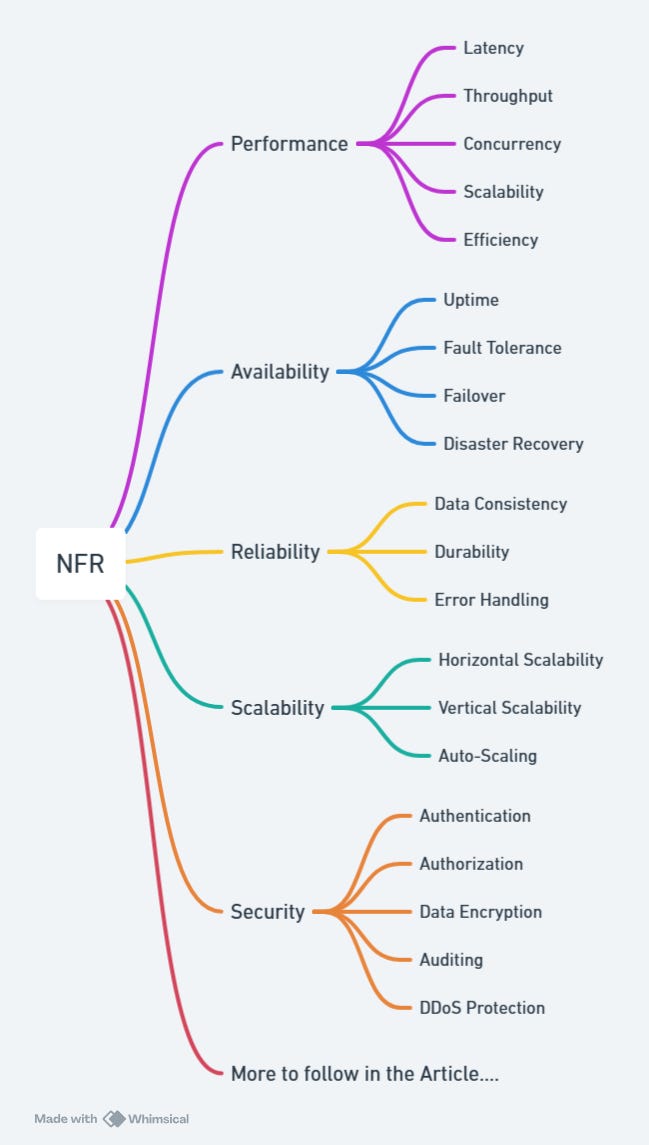
1. Performance
Latency: Maximum allowable response time for requests (e.g., ≤200ms for API responses).
Throughput: Number of requests the system can handle per second.
Concurrency: Support for multiple simultaneous users or transactions.
Scalability: Ability to handle increasing loads by scaling horizontally or vertically.
Efficiency: Optimal utilization of resources like CPU, memory, and disk I/O.
2. Availability
Uptime: Percentage of time the system must remain operational (e.g., 99.99% availability).
Fault Tolerance: Ability to continue operations despite hardware or software failures.
Failover: Switching to backup systems upon failure.
Disaster Recovery: Strategies for recovering from catastrophic failures (e.g., geo-redundancy).
3. Reliability
Data Consistency: Ensuring accurate and reliable data across components.
Durability: Guaranteeing data persistence even during crashes or failures.
Error Handling: Mechanisms to detect, log, and recover gracefully from errors.
4. Scalability
Horizontal Scalability: Adding more machines to distribute load.
Vertical Scalability: Enhancing resources of existing machines (CPU, RAM).
Auto-Scaling: Dynamically adjusting resources based on current load.
5. Security
Authentication: Verifying user identities (e.g., OAuth, JWT).
Authorization: Restricting user access to permitted actions or data.
Data Encryption: Encrypting data at rest and in transit.
Auditing: Logging actions for accountability.
DDoS Protection: Strategies to mitigate distributed denial-of-service attacks.
6. Maintainability
Code Maintainability: Ease of updating or modifying code.
Modularity: Dividing systems into manageable modules.
Documentation: Comprehensive guides for developers and stakeholders.
Monitoring: Dashboards and tools to monitor system health and performance.
7. Usability
Accessibility: Compliance with accessibility standards like WCAG.
User Experience (UX): Designing intuitive interfaces.
Error Feedback: Clear messages to guide users when errors occur.
8. Observability
Logging: Detailed logs for tracing issues.
Monitoring: Real-time alerts and dashboards for performance metrics.
Tracing: Distributed tracing to follow a request through the system.
9. Compliance
Regulatory Compliance: Adherence to regulations like GDPR, HIPAA, or PCI-DSS.
Auditability: Ensuring systems can be audited for compliance verification.
10. Cost Optimization
Operational Costs: Minimizing ongoing costs like compute and storage.
Resource Utilization: Efficient use of resources to reduce waste.
Cloud Optimization: Leveraging cloud-native solutions like spot instances.
11. Portability
Interoperability: Ensuring compatibility with other systems.
Platform Independence: Supporting multiple platforms (e.g., Windows, Linux).
Ease of Migration: Simplifying transitions to new environments.
12. Extensibility
Plugin Support: Adding new features without major code changes.
Future-Proof Design: Adapting easily to future requirements.
13. Auditability
Action Tracking: Detailed logs of user and system actions.
Version Control: Maintaining a history of changes to code or configurations.
14. Localization and Internationalization
Language Support: Supporting multiple languages.
Time Zone Handling: Adjusting for global time zones.
Cultural Adaptation: Tailoring UI/UX for regional preferences.
15. Resilience
Graceful Degradation: Partial functionality during failures.
Self-Healing: Automatic detection and resolution of issues.
Backup and Restore: Efficient processes for restoring data.
16. Responsiveness
Interactive Systems: Quick responses to user interactions.
API Responsiveness: Handling edge cases without significant delays.
17. Interoperability
API Compatibility: Seamless integration with third-party tools or services.
Data Exchange Standards: Supporting formats like JSON, XML, or protobuf.
18. Data Retention and Archiving
Retention Policies: Specifying how long data is stored.
Archival Strategy: Moving infrequently accessed data to cost-effective storage.
Deletion Standards: Securely deleting data when required.
19. Transaction Management
ACID Compliance: Strong consistency for critical systems.
Eventual Consistency: Relaxed consistency for distributed systems.
Compensation Mechanisms: Rolling back transactions on failure.
20. Configuration Management
Dynamic Configurations: Updating configurations without restarting the system.
Centralized Management: Single source of truth for configurations.
21. Data Integrity
Validation Mechanisms: Ensuring data accuracy and completeness.
Checksums and Hashing: Preventing corruption.
Schema Enforcement: Strict adherence to data schemas.
22. Backup and Restore
Automated Backups: Regularly scheduled backups to prevent data loss.
RTO and RPO: Recovery Time Objective and Recovery Point Objective specifications.
23. Versioning and Release Management
API Versioning: Backward compatibility for existing clients.
Feature Toggles: Dynamically enable/disable features during deployment.
24. Adaptability
Dynamic Scaling: Automatically adjusting resources based on traffic.
Configuration-Driven Behavior: Behavior changes without code updates.
25. Ethical and Environmental Considerations
Energy Efficiency: Reducing power consumption.
Bias Detection: Ensuring fairness in ML models.
Sustainability: Designing eco-friendly systems.
Conclusion
Addressing NFRs is essential for building systems that are not just functional but also reliable, secure, and user-friendly. By asking the right questions and considering this comprehensive list during system design interviews, you can showcase your understanding of quality attributes and create systems that meet real-world needs effectively.
Stay tuned for my next article, where I’ll discuss practical solutions to implement these NFRs in real-world systems!